
Showing posts with label Universe. Show all posts
Showing posts with label Universe. Show all posts
 |
| Doctor Who | Source: www.deviantart.com |
The End
But no, this end is not the one that would pave way for another beginning. Yet if you really persist on one not existing without the other (the end without a beginning and vice versa), call it the beginning of an eternal void? Whose end are we discussing and why does it sound so depressing? The quietus of our entire existence...physical, for those with faith in the alternate forms of existence. No, not just life...that would be so human of us, the conclusion of everything there ever was and will be, the grand stage...our universe (and all others perhaps?)
Of course, there are many around the world that have, do and will devote their lives to unraveling the early expansion of the Universe popularly known as the Big-Bang! That indeed, is a topic worthy enough of catching the imagination of young and old scientists alike. But, little thought is given or at least publicized on what awaits all of it at the end, what is the final fate?
The Theories
Inherently, we favor the availability of options, and just like the menu of a restaurant, we can choose from many available options to end things for good (haha?!) What would you like to treat yourself with today, sir? How about a Big Crunch or a Big Rip, perhaps a Big Freeze...I think you'd enjoy a Big Bounce! As appetizing as these may sound, with enough understanding, you'd want to get rid of them from your thoughts because they are the hypothesized endings of all of existence. Take, for example, the Big Freeze..ironically, it is nicknamed- heat death. Now, don't worry it is not death by heat...but rather, the death of heat itself. For what it's worth, the ambient temperature will be just 0K!


Let's understand the different ways everything we know can bid adieu to, well, everything. The Big Crunch, much like a poetic ending, results in everything contracting back to the point of singularity (all of the Universe condensed into a single point), probably followed by another Big Bang. Very similar to the cycle of life; there is birth and death and birth again. This requires a Closed Universe scenario. How about the Big Freeze or the heat death as they call it? This one has less drama than the Big Crunch, it results in the current expansion (proven by Edwin Hubble in the 20th Century) of the Universe reaches a point where everything is so far apart that the temperature approaches absolute zero (-273.15 degrees Celsius), soon the stars exhaust their fuel and cease to shine...one by one, the universe will witness it's lights go out. Darkness will pervade all of existence and what will be only left longer will be the Black Holes. But everything must end, and they shall too. Hawking Radiation, with time, will book them a place in the history. And that will be the end of it all...if the Big Freeze is true. The Big Rip lives up to its name, ripping apart everything there is to the most elementary form of matter as the increasing density of the inexplicable dark energy accelerates the Universe. This too, has a singularity at it's conclusion. Both, the Big Freeze and the Big Rip take place in an Open Universe.
Geometry & Scale
What in fact is a Closed or an Open Universe? Alexander Friedmann, a Russian Physicist, introduced the Density Parameter denoted by Omega () which is the ratio of observed to critical density as determined from the Friedmann Universe (spatially homogeneous and isotropic). The value of omega determines the geometry of the Universe. For values larger than 1, the Universe is closed like the surface of a sphere and for ratios less than 1, the Universe is open like the surface of a saddle. The critical value of 1 is a Universe that is flat.
 )
 |
| and this one's not happy. |
NASA's WMAP (Wilkinson Microwave Anisotropy Probe) confirmed that the Universe is flat indeed, with less than a percent of margin of error. Are you think how can the Universe be considered flat when we clearly argue against Flat Earth! How is it so when you can see the spatial difference between the seas and the mountain peaks, the streets and the skyscrapers...the planets, the suns and the moons. It all is a matter of perspective after all! No it does not mean that the Earth is flat, that one's still a big NO. But, these measurements hold true for scales ~100 Mpc (mega parsec, it's a HUGE distance). To put things into further perspective, a parsec is about 3.26 light-years which is 31 trillion km's. Do the calculations for 100 Mpc (mind=blown?). The existence of dark energy plays a trivial role, and that has made the fate of Universe more inclined towards that with an Open Universe geometry (Big Freeze, Big Rip).
Sometimes, to understand the macro, it becomes essential to study the micro scale. In either cases of Big Freeze and Big Rip, what's left for the finale is either the exhaustion of Black Holes by Hawking Radiation or the disintegration of everything to the smallest of particles and their further decay.
Now that the grand scale has been covered, let's dive into the grandeur of...time.

This is an atom, helium to be exact. Two protons, two neutrons and two electrons. As opposed to humans, elementary particles tend not to go rogue when required to confine themselves to a group for stability. While the atom itself is stable, the elementary particles that make up, this and infinite other combinations of atoms and molecular compounds, are not always stable on their own. This phenomenon of transformation of the free elementary particle, is termed as decay. How is the decay of subatomic entities pertinent the end of the Universe or the grandeur of time? If the Big Rip and Big Freeze do indeed happen, what will be left? These elementary particles, and only they shall live to see the end of it all. Their decay is perhaps the last event to mark the finale. And that will be a long and slow one! Better than a slow death to the conscious mind, eh?
Let's take a free neutron, if you'd been reading carefully, we know what's going to happen next- decay. A neutron, slightly heavier than the proton, is not as stable as a proton can be. Nature strives for stability with far more determination than we do, but then again, we are a microcosm of all that we see. A neutron (neutral), to attain a more stable state, decays into a proton (positive charge). But wait, as do the Lannisters, chemical reactions also always pay their debts...to Thermodynamics. THE LAW OF CONSERVATION. Mass must always be conserved in any transformation and so, along with the generation of a slightly lighter proton, an electron (negative) and an electron anti-neutrino is formed. Now, there is balance!
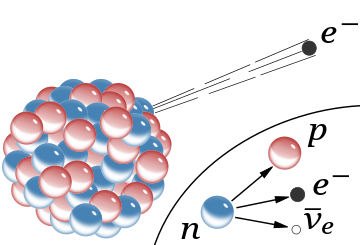 |
| Free Neutron Decay | Source: Wikipedia |
So, we started with a neutron and ended up with proton, electron and electron anti-neutrino. Not only was the mass conserved but also the charge (n0 →
p+ +
e− +
ν
e). It is essential also to know how long this process takes. The concept of Half-Life explains the time it requires for a particle to decay to half the amount it started with. For a free neutron, this half-life is 10 minutes 11 seconds and it completely decays in 14 minutes 42 seconds (it is a logarithmic function).
But this is just the beginning.
 The Big Rip scenario concludes with the disintegration of all matter to its most elementary form. Let's assume that we end up with a bunch of stable protons. Combining this with Big Freeze, we also have quite many Black Holes floating around the Cosmos. We can't just stop here. The quest of Science does not end at answers, it really also begins questioning those answers. What happens once we have stable protons? Do they NOT decay? Of course they do! And how do we find that? Calculating its half life! Nothing is invincible.
Proton's have a half-life of 1032 years. To give some perspective, the estimated age of our Universe is ~1010 years. Did it ever occur to you reading this, why don't we decay, we're made out of protons?! Yes, we do have protons, every atom has a proton at its center, the nucleus. But, the game is all about the stability. Life is made from carbon compounds, these are variations on the arrangement of molecules of carbon and other atoms. But they are stable! And we need not worry about their decay (TGIM- thank god its mortality).
Fast-forward 1050 years, we have reached the period where all the protons have decayed. Nothing to make up matter anymore, what's left now? BLACK HOLES (which aren't black really, but does it matter if you can't see them?) A Universe full of giant black holes BUT they die too. As we learned earlier, Hawking Radiation at the event horizon of a black hole is responsible for its death. How long would it take for a Black Hole to disappear? For a Black Hole the mass of our Sun (~1030 kg), it would evaporate by the radiation in 1074 seconds. Knowing that a year has ~ 107 seconds, it will take approximately 1067 years. But black holes are rarely as small as our Sun. How about a Black Hole that is 10 billion times more massive than Sun? That's an enormous 10104 seconds or 1097 years!
That's it then, first the protons decay and then the Black Holes evaporate. Darkness shall prevail. No.
There is an elephant in this cosmic ballet that has elusively pirouetted swiftly across our vision.
Let's see the composition of our Universe. You would be surprised to know, all that we can see around us and through our ginormous telescopes, matter- makes up only 4.6% of the observable Universe. Dark Matter (responsible for gravitational effects) constitutes 24%. Although it has never been directly observed, the effects are measurable on its surrounding. But that still leaves 71.4% of unexplained composition of the Universe. And this is Dark Energy. The 'dark' reflecting its mysterious nature, yet to be known. Don't be surprised, we have had encounters with Dark Energy many times in this post. Remember the Flat Universe, resulting in the same fate as an Open Universe. All thanks to the effects of Dark Energy. The extreme expansion in the Big Rip, that's also a consequence of Dark Energy. And finally the Big Freeze situation, I believe you know it, yes, Dark Energy.
That is exactly the nature of the pursuit of science. Questions lead you to answers only to lead you to many more questions! What must Dark Energy be? How gravely could it alter the fate of our Universe. Is this where after-life is, or the higher dimension? We are witnessing less than 1/25th of the Universe, how can we then assume we have all the answers based on observations of limited facts. How do we pretend to be so sure of existence and why do we believe in absolutism. Is this our naivety or unbending conviction? It is everywhere around us, yet nowhere in our existence, nowhere in our thoughts. Can we afford to neglect what makes up more than three quarters of our Universe and expect our truths and facts to be the ultimate answers? Astronomy is indeed a humbling experience.
p+ +
e− +
ν
e). It is essential also to know how long this process takes. The concept of Half-Life explains the time it requires for a particle to decay to half the amount it started with. For a free neutron, this half-life is 10 minutes 11 seconds and it completely decays in 14 minutes 42 seconds (it is a logarithmic function).
But this is just the beginning.

Proton's have a half-life of 1032 years. To give some perspective, the estimated age of our Universe is ~1010 years. Did it ever occur to you reading this, why don't we decay, we're made out of protons?! Yes, we do have protons, every atom has a proton at its center, the nucleus. But, the game is all about the stability. Life is made from carbon compounds, these are variations on the arrangement of molecules of carbon and other atoms. But they are stable! And we need not worry about their decay (TGIM- thank god its mortality).
Fast-forward 1050 years, we have reached the period where all the protons have decayed. Nothing to make up matter anymore, what's left now? BLACK HOLES (which aren't black really, but does it matter if you can't see them?) A Universe full of giant black holes BUT they die too. As we learned earlier, Hawking Radiation at the event horizon of a black hole is responsible for its death. How long would it take for a Black Hole to disappear? For a Black Hole the mass of our Sun (~1030 kg), it would evaporate by the radiation in 1074 seconds. Knowing that a year has ~ 107 seconds, it will take approximately 1067 years. But black holes are rarely as small as our Sun. How about a Black Hole that is 10 billion times more massive than Sun? That's an enormous 10104 seconds or 1097 years!
That's it then, first the protons decay and then the Black Holes evaporate. Darkness shall prevail. No.
 |
| ...until its over. |
Let's see the composition of our Universe. You would be surprised to know, all that we can see around us and through our ginormous telescopes, matter- makes up only 4.6% of the observable Universe. Dark Matter (responsible for gravitational effects) constitutes 24%. Although it has never been directly observed, the effects are measurable on its surrounding. But that still leaves 71.4% of unexplained composition of the Universe. And this is Dark Energy. The 'dark' reflecting its mysterious nature, yet to be known. Don't be surprised, we have had encounters with Dark Energy many times in this post. Remember the Flat Universe, resulting in the same fate as an Open Universe. All thanks to the effects of Dark Energy. The extreme expansion in the Big Rip, that's also a consequence of Dark Energy. And finally the Big Freeze situation, I believe you know it, yes, Dark Energy.
 |
| a pursuit beyond the equations. |
That is exactly the nature of the pursuit of science. Questions lead you to answers only to lead you to many more questions! What must Dark Energy be? How gravely could it alter the fate of our Universe. Is this where after-life is, or the higher dimension? We are witnessing less than 1/25th of the Universe, how can we then assume we have all the answers based on observations of limited facts. How do we pretend to be so sure of existence and why do we believe in absolutism. Is this our naivety or unbending conviction? It is everywhere around us, yet nowhere in our existence, nowhere in our thoughts. Can we afford to neglect what makes up more than three quarters of our Universe and expect our truths and facts to be the ultimate answers? Astronomy is indeed a humbling experience.
How Far Have We Come ?
 |
| How Far We Have Come |
The Universe we know about came into existence about 13.8 billion years ago. That very moment, everything around you see around yourself burst out from a singularity. If you consider the Universe infinite in size, you can say that the Big Bang happened everywhere, even in the exact place where you are sitting right now. There was no matter in the early stages of the universe and not even light existed then. It was only about 380,000 years later that the light from the Big Bang embarked on an eternal journey which scientists now call the CMB (Cosmic Microwave Background Radiation).
 |
| Cosmic Microwave Background (Source:Wikipedia) |
Quite a lot has happened since then, for instance, 13.8 BILLION Years have passed! Hundreds of millions of stars that light up our night sky have and are still being created in stellar nurseries. Planets and galaxies were created forming clusters of giant Galaxies. These galaxies now host hundreds of billions of stars which are probably shelter to thousands of billions of planets. These numbers sound way too big right? But that's not it, the universe also gave birth to some fascinating structures like Supernovae which mark the death of a star, Neutron stars that are incredibly dense and have extreme rotational velocity and mysterious stuff like Black Holes which can't even be precisely defined right now. But a lot more has happened here itself on our blue planet Earth. Some of which isn't even related to the physical phenomenons produced by this Universe. It is believed that our Sun is 5 Billion years old and the same is for our Planet. Data collected strongly suggests that our planet and the 7 neighbor planets were created from the Sun during our star's formation. This can be related to how the Moon was created from our Planet Earth.
Life is supposed to have started by chance in a primordial soup(pond) of organic chemicals about 3.6 Billion Years ago. There is still a debate on whether the reactants responsible to kick start Life on our planet were transported by meteors from other worlds or resulted from fortunate combination of compounds present on Earth. It wasn't until 3.4 Billion years ago that cyanobacteria started performing photosynthesis. These unicellular organisms evolved into complex life including everything you see around in "nature". The lovely fragrance of the lilacs, the cheerful face of a Dolphin, the yawn of a kitten (are you reading Salma?), all of that exists due to a chemical reaction dating 3.6 billion years back. Humans have wandered the planet for only 200,000 years now and I think we have accomplished a LOT though it's still very LESS. First humans are said to have lived in Africa who then traveled to other continents. The first humans to have lived in the Continent of Americas date back only 14,500 years. Not even close compared to the 5 billion year old Earth and Solar System.
 |
| Destruction of Earth by Humans |
It took more than a billion years for complex life to evolve from unicellular organisms after origin of Life but it took only 14,500 years for Earth to witness countless conflicts(literally) , fall and rise of great empires, two shattering World Wars , murders of millions of innocents, depletion of resources which took eternity to be formed, division of land on the basis of color and views, etc. Seriously, do you want to be remembered as a part of a civilization responsible for all this?
Keeping that aside, in just about 15000 years of existence, Humanity has gathered and produced a plethora of information. The flame of curiosity in the souls of humans has helped humanity reach the frontiers of science and other fields. The internet you're using right now is an excellent example. We started from the forests and now live in the concrete forests we built ourselves from our thinking(irrespective of whether we like living in it or not). We humans learned the art of survival from nature and now have completely changed our way of living, survival still exists but not exactly in the 14000 year old form. Today's survival depends on how well you score on your test or how good of a person you are in your society. Your strength or your physical ability is nothing but just a hobby today which would have been considered the most important factor for survival back then. We built civilizations that were controlled by a single ruler, created systems that ran a whole country and what not. Our imagination paved the way to almost every place we dared to discover. In only 400-500 years, we turned from using pigeons to instant messaging for communication. We are now able to keep surveillance on a bottle of water from hundreds of kilometres above surface.

Great minds like Nikola Tesla, Sir Isaac Newton, C.V.Raman, Albert Einstein, Ramanujan walked and died on this planet. We have developed machines that execute work once thought to be impossible by the highest of intelligence. Invention of electronics like telescopes which enable us to stare back into the history of our Universe has only become possible in the last few hundred years. There are our representatives out there like Voyager and Cassini and Rosetta who have voyaged distances no man-made product has ever achieved. We landed on moon just a few decades back but our knowledge of the universe beyond it is literally jaw-dropping and we still continue to explore this uncharted territory once thought to be inconceivable to the human brain. We have created and managed to run super-organisms like cities and countries. And I can't even imagine what else can we concur in the coming years, decades, centuries and millenniums! Humanity can be considered as a light of hope for this Universe to understand itself, maybe that's the reason the Universe created us... or maybe not.

Today, the whole world runs by the tick of the clock. Each and every second, thousands of millions of dollars worth transaction takes place, lives change, economies build up, societies change,etc. We live in this chaotic world where everything seems so well organized. But wait, we didn't start like this. At the beginning, it was just a bunch of tribes living their lives with the only aim being survival. It is clear, over the period of time, which is not very long on the Cosmic scale, that we've CHANGED the game "nature" planned out for us. I think it's fair to say that we've really come quite far for where we once started... but the journey's not over yet...it will never be...
PILLARS OF CREATION
 |
| Pillars of Creation (Source - Wikipedia/NASA) |
- What are the "Pillars Of Creation" ?
- Why is it important?
- Really that far?
- So big?
- Is it dead?
What are the "Pillars Of Creation" ?
>>>> The "Pillars Of Creation" is an incredibly wonderful thing! It's a photograph taken by the renowned Hubble Telescope in the year 1995. The location of this image is 7,000 light years from Earth and located in the Eagle Nebula.(Yes, it's Seven Thousand Light Years!) It's nothing but just a multi-colored picture of a gigantic cloud gas and dust. Curious why it's "Pillars Of Creation" then? This very cloud of gas and dust is where the stars come to BIRTH! This is one of the many,many nurseries of stars out there! Yes, Stars are formed in such visually beautiful places... The basic composition of these gas pillars is cool molecular Hydrogen. This wasn't taken in just one picture. 32 different images from 4 different cameras were used to form the above image. Due to the magnified lens of the cameras, the stair shaped pattern at the top right was formed. Wonder why it's so colorful? The green light is due to Hydrogen, red being from Sulfur which was singly-ionized and blue is from the doubly-ionized Oxygen atoms.
 |
| Herschel Observatory Image |
Why is it important?
>>>> The Pillars are of great important for cosmological studies about the conditions,elements,space required for the Birth Of Stars.The Nebula is located about 7,000 light years but still can be viewed from a decent telescope in your backyard! Till date, the pillars have provided the space researchers with essential information regarding the birth of various types of stars. Also, astronomers haven't been able to detect quite a lot of "nurseries" located at such distance. It was a remarkable achievement for the scientists when the Pillars of Creation was pictured. The location of this Nebula might not be at an ideal location from Earth but is enough for researchers to get the required data. Scientists were not able to study the formation of stars until the Pillars were found by Jeff Hester and Paul Scowen then at Arizona State University. The iconic pillars have been a subject of interest since detected!
 |
| Image from Observatory located on Earth (Pillars in the middle) |
Really that FAR ?
>>>> These Pillars are located at a distance of about 7000 light years from Planet Earth. Wanna know how far that is? Then let's do some calculations first ...
1 Light Year = 9.4605284 × 10¹⁵ meters
= 9.4605284 × 10¹² kilometers
so, it's approximately about 9.4 with 12 zeros after it. Imagine how much would it be for 7000 Light-Years! You do the math!
Seriously that Big ?
 |
| Source - FQTQ |
First, take a look at the picture >
Look carefully and you'll see a small finger-like image at the top of this pillar. Can you imagine how vast is it? Well, it's the size of our solar system!!! I guess "befuddled" would be the correct word to express anyone's brains situation after reading that.
The pillars are so long that the measure is not expressed in millions or trillions of kilometers but Light Years! This pillar is the left most pillar and is approximately 4 light years in length.
Again, we're gonna do some basic calculations,
There's 60 seconds in a minute and 60 minutes in an hour. And then there are 24 hours in a day. 365 days in a month and the length is 4 years(sounds funny right?) and the last; 299,792 i.e. the speed of light.
60 X 60 X 24 X 365 X 4 X 299792 = 37816962048000 Km.
or
37 Trillion 816 Billion 962 Million 48 Thousand Kilometers :)
Now that's just the size of these "giants". Remember the calculation we previous made about the relation between 1 Light Year and Km's? Try to apply that hear and be ready to face what I say, "moments of cosmic numbness". Moving on then...
So, it's DEAD ?
 |
| Maybe Dead? (Source - FQTQ) |
Whenever you look at the sky every night, everything you see is the past! All of it! It may be some seconds,hours,days and even thousands of years..but the PAST. Back to our topic, see the red gas in the image above? That's the gas in that cosmic region heated up due.The reason for this is a spectacular yet calamitous event, a supernova. Supernova is an exploding star,one of the most amazing events of our Universe. Theories suggest that the shock-waves formed due to the supernova may have damaged or knocked down the Pillars of Creation. This event is supposed to have happened at least 6000 years ago. The pillars being at 7000 light years is the reason why we haven't seen it yet. This means that Earth would be able to see this devastation about 1000 years from now. The Earth-lings then would see these pillars fall apart and annihilated by the extreme shock waves of the supernova. They will know that the even happened a long time ago,but it'd still be a miserable and disheartening moment!
As FQTQ say "We are merely spectators,relegated to the lowly role of simply watching and trying to make sense of the cosmos."
We must feel privileged to be able to witness such wonders happening around us! We can't do anything but watch the chaos around us and how it brings order to itself, our Universe.That is the beauty of our Cosmos!
Enjoy everything you see above and around you, because it's there after a long struggle! The Universe made it for you!
Our Wonderful Universe!

Seven billion people live on this planet yet only some of them actually take interest to gaze at the stars at night and think about the vastness that we are a part of.... How lonely are we and why must we consider ourselves unique?! 7 billion people, most trying to just live through their life. Why? Because they're told to. The definition of life for "them" is just making everyone around them happy and earning enough for a comfortable lifestyle. That's it, nothing else..and yes,some recreational activities so that you don't get frustrated. This is how their life starts and ends. They might say that whatever they did in their life made them happy and then give examples of some really interesting and emotional moments they experienced in their lifetime which apparently made them "happy"...but in this "pursuit of worldly happiness" they miss the ACTUAL wonders out there! I don't hesitate to say that they're just some creatures in a pond(no offense).

There's so much to explore, so much to gaze at and soooo much to wonder about! If you just looked at the sky on a clear night and gave it a thought....you would understand our uniqueness and the incredible cosmic realm we're a part of. The depths to which you would go about thinking while gazing at those twinkling stars is immeasurable. Everything out there has an incredibly long story behind it,mostly a tragic one. The stars, the cosmic clouds, and even the light from them that's reaching you! You'd be shocked to know that everything that you're seeing above you happened a few light years to a hundred light years ago... Now that's fascinating right? Does it mean that one of the stars you're looking at might not be twinkling right now? Yes! That's a considerable possibility!

Some of these "pond creatures" might expand their thinking and may wonder about the planet Earth. Thus, they thank the nature and feel blessed to be living in such conditions. BUT! Ever thought about the iron in your blood? The gold jewelry that you own? The silicon in your electronic equipment's? You might not know and possibly be shocked to know that all of it once burst out through a "dying star". A star that formed due to the cosmic clouds that you gaze at, the star that shined most of its lifetime, the star that lived a BILLION years...yes, that STAR! And then the star died...but gave you such precious elements. The blood running through your veins is STARDUST! So think a million times before hurting yourself because a star died for you.You are made of something that caused a star to explode..that's IRON! You are wonderful, you are unique, you are a STAR!(figuratively)
There are so many things out there which would befuddle you extremely! So much to see that you would stop going to art galleries but just use a telescope(not that art works aren't wonderful,they are!) This COSMOS will never cease to amaze you with it's "ever-lasting artwork".There's so much going on out there that you're a part of but still,some prefer to ignore it and lead on with their "earthly-life".Still choose to ignore it? No? Then..
GO OUT!
GAZE AT THE SKY!
FEEL WONDERFUL!
FEEL UNIQUE!
why? Because,
You're PART OF A WONDERFUL UNIVERSE!
